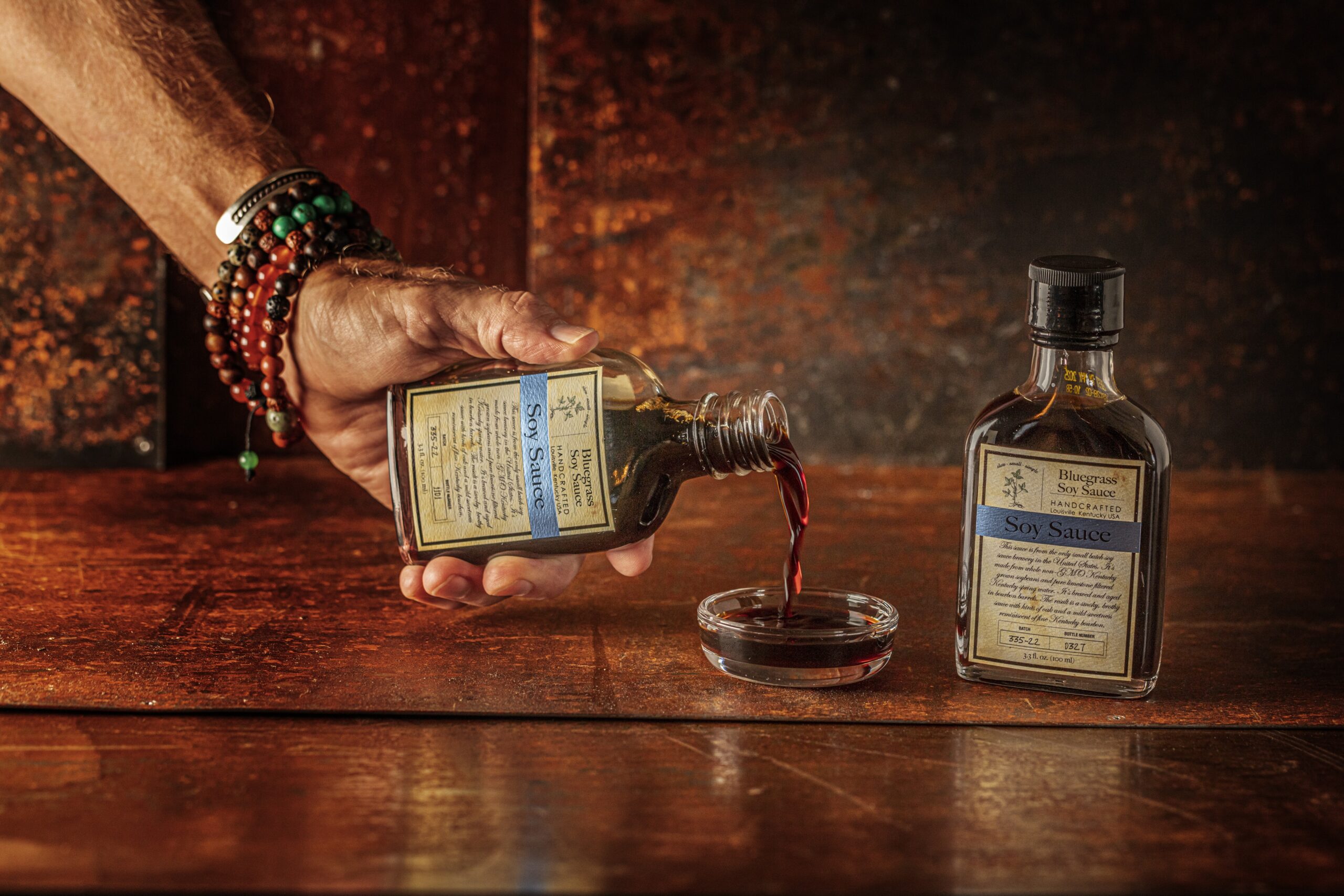
Brewed the Japanese way, aged in what bourbon left behind.
Matt Jamie was a classically trained chef in Louisville, Kentucky, with no background in food manufacturing and no connection to soy sauce. He picked soy sauce because nobody else in the United States was making it, taught himself the process in his basement, and started selling in 2006.
Twenty years on, Bourbon Barrel Foods still presses Bluegrass Soy Sauce by hand. The barrel is the part of the story as it is with that other famous liquid from Kentucky.
At a Glance: Bluegrass Soy Sauce
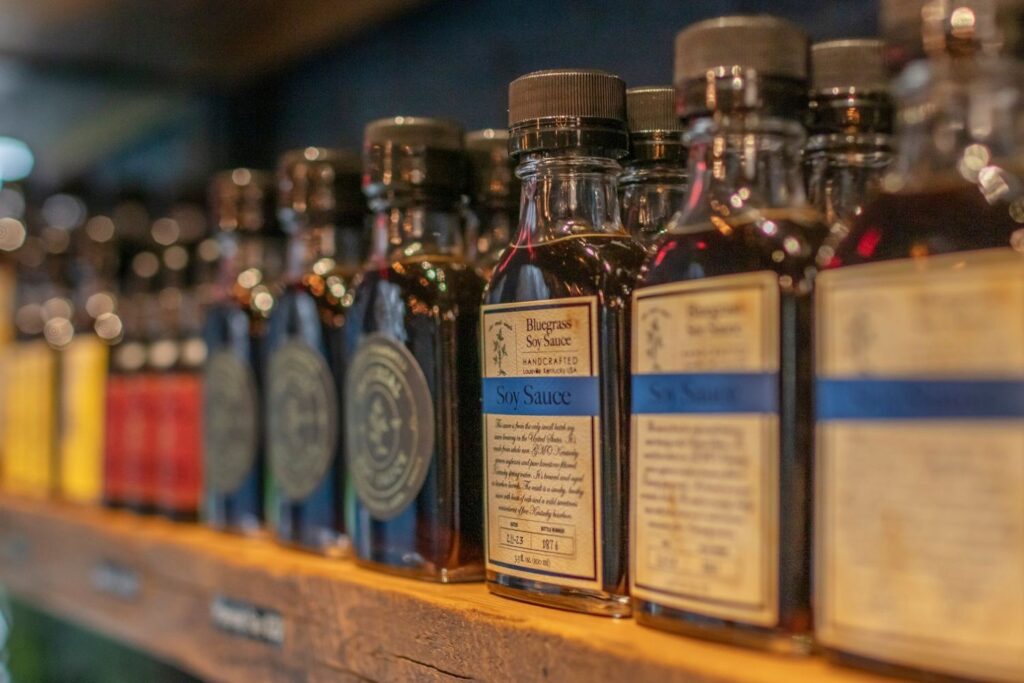
Bluegrass is the base for everything else on the shelf, including a double-fermented Imperial and a smoked expression.
| Characteristic | Bluegrass Soy Sauce |
| Brewing Method | Naturally brewed |
| Aging Duration | 12 months |
| Fermentation Vessel | Used bourbon barrel |
| Soybean:Wheat Ratio | 50:50 |
| Ingredient Quality | Non-GMO Kentucky soybeans, Kentucky soft red winter wheat, limestone-filtered water, solar-evaporated sea salt |
| Total Nitrogen | 1.32% (8.52% protein) |
| Primary Taste Profile | Meaty, brothy, briny and leathery with a subtle sweetness |
| Aroma Profile | Smoky, earthy, oak |
| Regional Style | Koikuchi |
| Recommended Uses | Finishing sauce, sashimi, all-purpose cooking, braising and stews |
Kentucky Was Already Halfway There
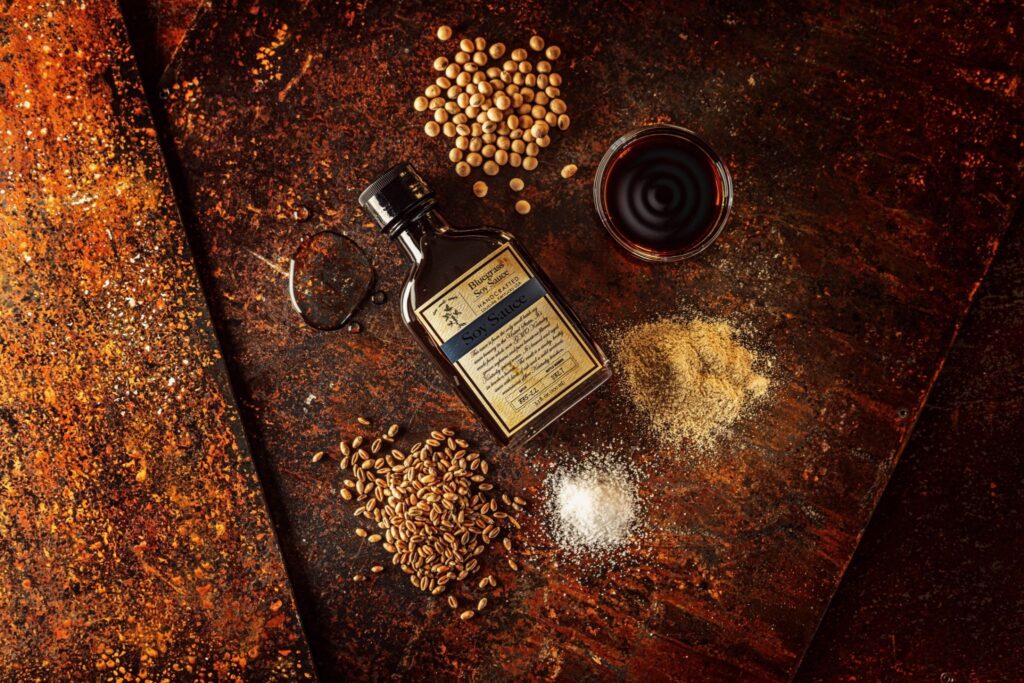
Everything in the bottle starts here, plus the water and the fermentation year.
Kentucky sits on limestone. Rain filters down through it and comes back up carrying calcium and magnesium and, more importantly it is stripped of iron. Louisville Water credits that geology, laid down roughly 450 million years ago, for it is the same water the bourbon industry runs on. Iron interferes with fermentation and muddies color, so distillers spend real money removing it. Kentucky never had to.
Bourbon Barrel Foods brings its water in from a Bardstown spring, the same source many famous Bourbon distillers use. The mineral load is the point, not something to be engineered around. Jamie says it makes “a bold product perfectly suited for the American palate.”
That’s a departure from Japanese practice, not an imitation of it. Brewers in Tatsuno, the birthplace of usukuchi, prize the soft, low-mineral water of the Ibo River precisely because it lets fermentation run slow and clean. Kentucky’s water pushes the opposite direction, and Jamie is building toward a different result.
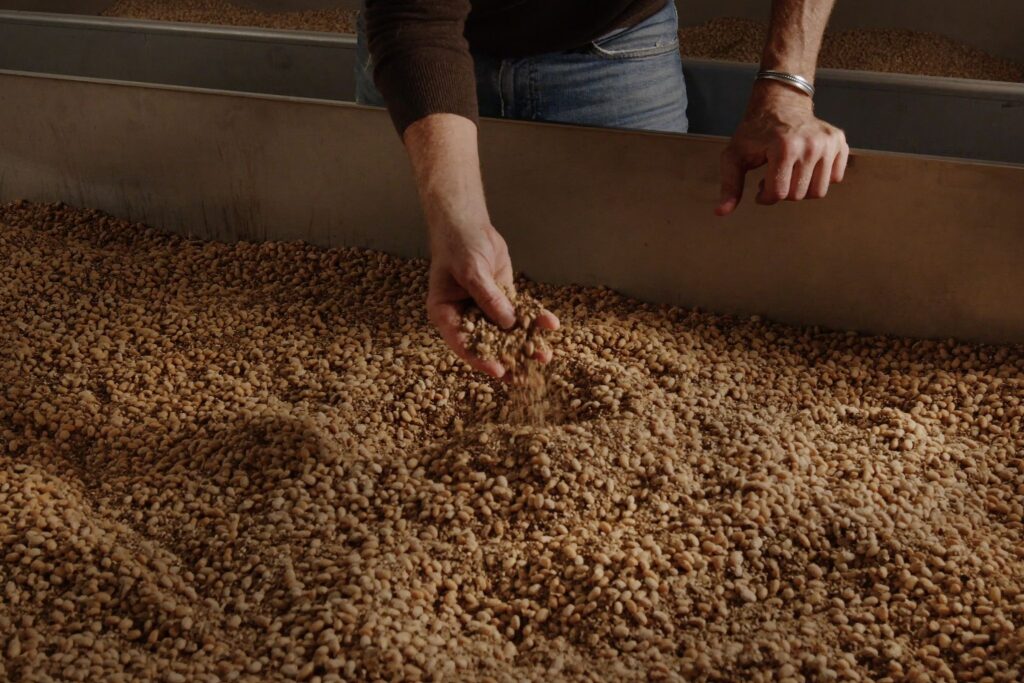
Before the barrel gets any credit, soy sauce is a trough of beans and wheat.
The rest of the ingredients are sourced locally: non-GMO soybeans from Marion County and Kentucky soft red winter wheat, in a 50:50 soybean-to-wheat ratio that puts Bluegrass squarely in koikuchi territory. The wheat comes from the same farmer who grows it for Maker’s Mark, the Loretto distillery that swaps wheat for rye in its bourbon. The only ingredient outside of Kentucky is the solar-evaporated sea salt that travels in from the Pacific Coast.
Japan, South Korea and Taiwan are historically the leading buyers of American food-grade non-GMO soybeans, and a share of that crop goes into soy sauce. Japanese brewers have been making soy sauce on U.S. soil, from U.S. crops, since the 1970s.
Jamie didn’t have to go hunting for a bean with soy sauce credentials. His grower had them. “Our soybean grower already sells his non-GMO beans directly to the Japanese soy and miso market,” he says.
The Barrel Is a Byproduct
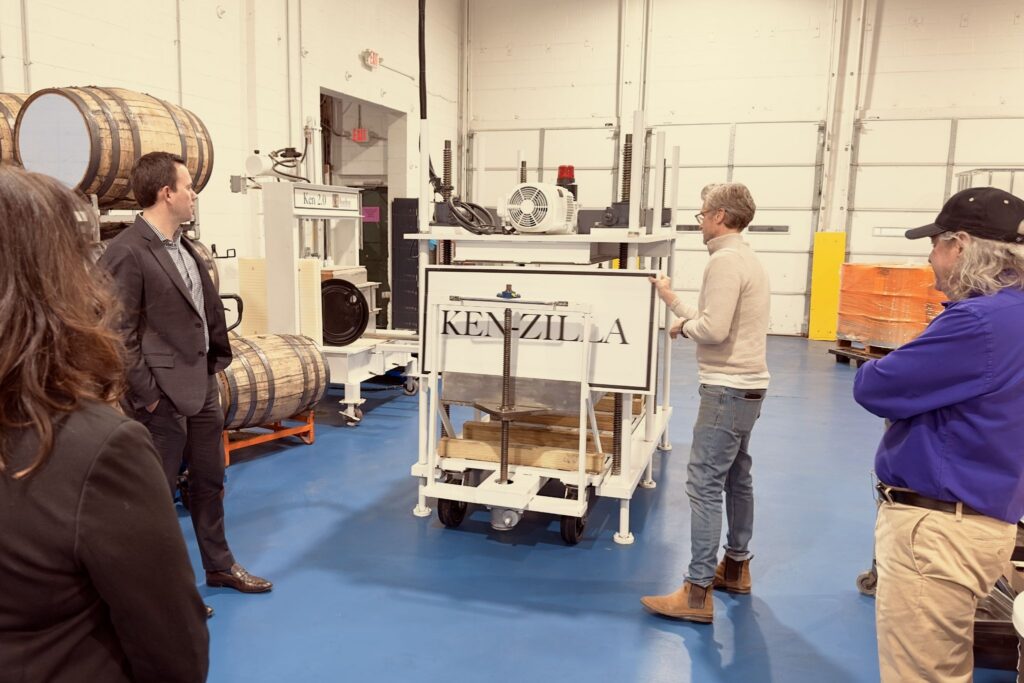
A year in the barrel ends here, at the one machine in the process they had to build themselves.
Federal law is specific. To be called bourbon, whiskey has to be stored in charred new oak containers, so every barrel can legally hold bourbon exactly once. Kentucky therefore produces a permanent surplus of used barrels, and they are resold to age scotch, rum, beer and even hot sauce. Bourbon Barrel Foods sources its own from Woodford Reserve.
The mash ferments inside a barrel for 12 months, then goes to a press the company built itself and named KenZilla, after Jamie’s father, Ken, who built the three presses before it. The oak and smoke come from the barrel. The meatiness and brine underneath them come from the ferment.
To Jamie, the wood is a flourish, not a shortcut.
“The opportunity to take shortcuts is always there, especially when scaling,” he says. “Small-batch doesn’t automatically mean good, because intent matters from ingredients and process all the way to packaging and the dining table.”
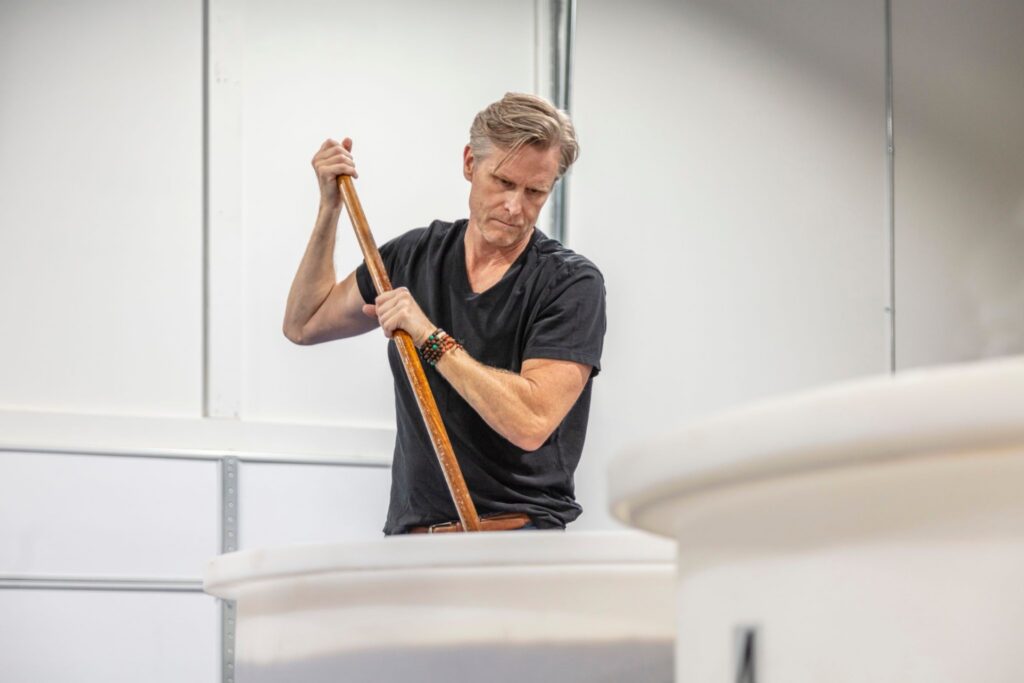
Matt Jamie works a batch by hand. Twenty years in, the job still comes down to a long wooden paddle.
It is still a labor of love process and no part of it is automated since they started in their basement.
Inside the barrel, the chemistry is the same chemistry at work in any naturally brewed shoyu. “During fermentation, glutamates are actively forming to build deep flavor, colors are changing, and the proteins in the beans and wheat are denaturing,” Jamie says.
Those reactions take time as saltiness is the quality most people attach to soy sauce, and Jamie explains it’s more than just a seasoning, because it’s a vital, necessary part of the process. It holds off spoilage organisms while koji enzymes and salt-tolerant yeasts and bacteria do their slow work, which he says can’t be done properly in under six months.
Bluegrass understands that and without declaring it on the label the liquid is aged for many months beyond six months for that is the product they want to offer.
Where Bluegrass Lands on Japan’s Scale
Jamie on how a chef with no manufacturing experience ended up brewing soy sauce.
All of that care depends on someone noticing. Recognition is the one thing Jamie can’t make by hand.
“I want consumers to understand that premium soy sauce exists in the same way there are distinct grades of balsamic vinegar, olive oil, sea salt, bourbon and wine,” Jamie says.
Quality in soy sauce is measurable, and Japan has been measuring it for decades. Under the Japanese Agricultural Standards, koikuchi is graded by total nitrogen, the closest thing the category has to an umami meter. Higher nitrogen means more amino acids, and amino acids are where soy sauce gets its depth.
Standard grade begins at 1.2 grams per 100 milliliters and the top tier starts at 1.5. Every grade in between is inspected and marked.
Bourbon Barrel Foods produces Bluegrass at 1.32%, clear of the floor Japan sets for koikuchi and short of its top tier.
In Japan that would earn a mark on the label. In the United States there is no additional recognition for there is no equivalent grading system. At this time nothing requires a brewer to measure and show the result, so the label declares what the FDA asks for and no more: sodium, carbohydrates, a gram of protein.
Part of why no such system exists is timing. Japanese soy sauce only reached U.S. supermarkets at scale after the 1950s, and a small number of commercial products went on to define what most shoppers expect. Jamie says the expectation stuck.
“Our efforts have been focused on changing the preconceived idea that soy sauce is just a brown, salty ingredient,” he says. “The fun part, though, is helping people realize that it is a brewed, fermented product that can be made artisanally.”
How to Taste It
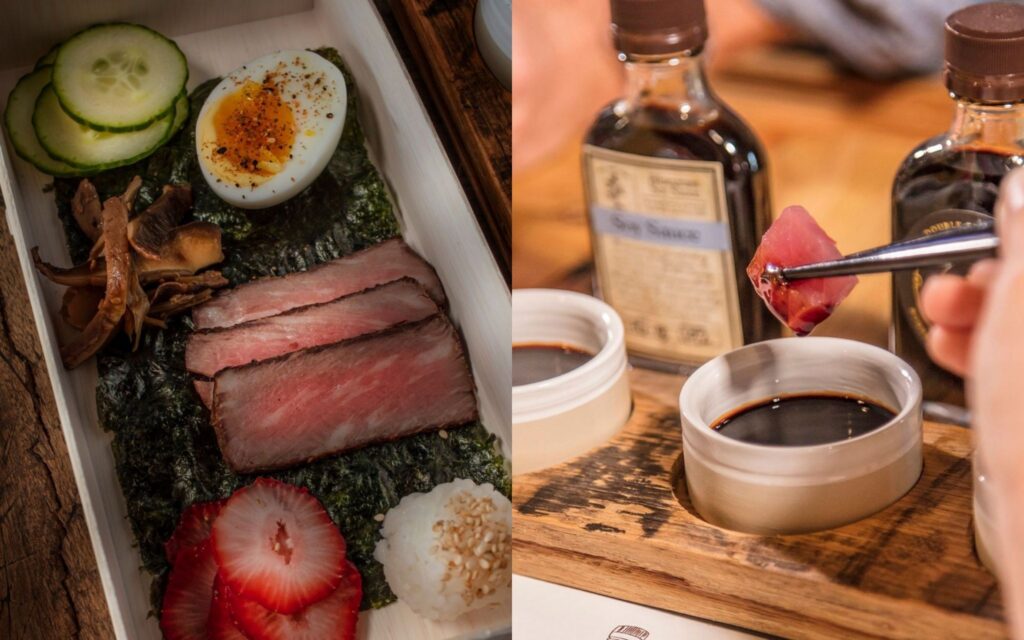
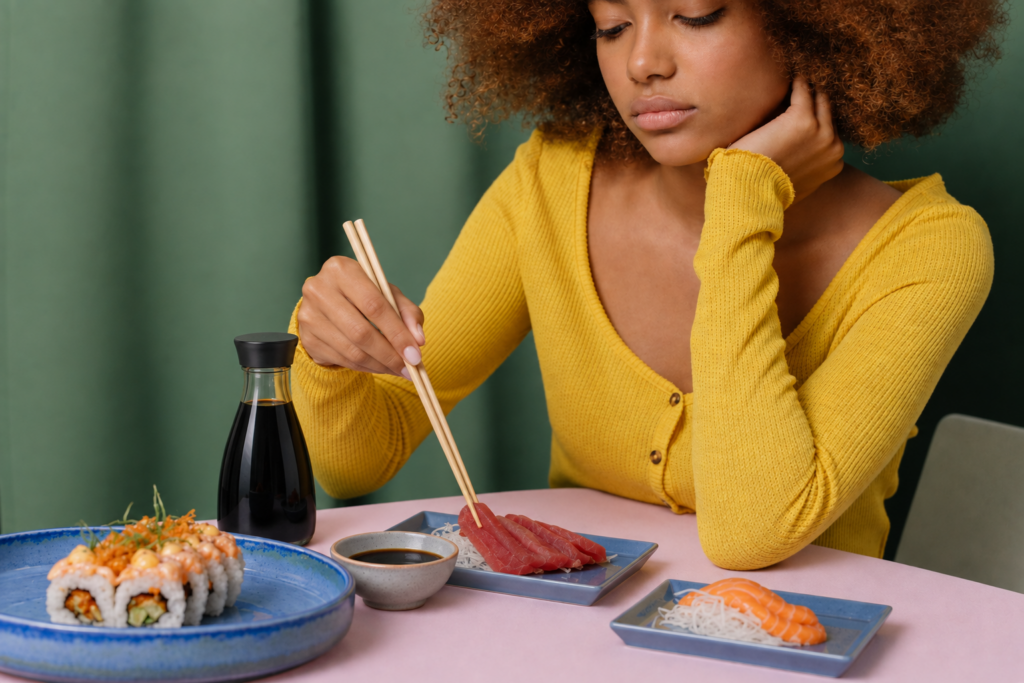
Left, the box Jamie brings to tastings. Right, the sashimi pairing he points people to first.
Nothing on a shelf can convince a shopper the sauce is any different, so Jamie does it in person. His demonstration is a box: melon, a soft-cooked egg, cucumber, steak and roasted mushrooms.
The melon does the heavy lifting. A few drops on ripe fruit cut the sauce loose from any association with stir-fry and leave the salt-and-sweet contrast exposed. The egg and the mushrooms work the same way. The sauce isn’t the flavor. It’s the amplifier.
“For many years, I could proudly say I was the only small-batch soy sauce brewer in the U.S., or even outside of Japan. I am not the only one anymore, but I never actually wanted to be the only one because competition is healthy and being alone is lonely. I love the growing community of soy sauce brewers out there today because they help tell the story of how and why this craft matters.”
Matt Jamie, Founder and CEO, Bourbon Barrel Foods
Bluegrass isn’t a Japanese soy sauce made in Kentucky. It’s a koikuchi-style soy sauce built from Kentucky’s own water, grain and oak, which is a harder and more complex claim. The barrel is what gets it off the shelf. Everything Jamie refused to make easier is in the bottle, and no label in the country is built to say so.
Bourbon Barrel Foods is based in Louisville, Kentucky. Bluegrass Soy Sauce is available through bourbonbarrelfoods.com and select retailers.
All images courtesy of Bourbon Barrel Foods.