It crossed the Pacific in clay jugs, survived a law written to keep its owners out, and hitched a ride on a plate of chop suey into every American town
Soy sauce became an everyday American seasoning thanks to Chinese immigrants. They brought it to California during the Gold Rush, cooked with it in restaurants that Americans flocked to, and created the demand that put it on grocery store shelves. The packet of soy sauce in your take out bag, what sits in your pantry and on the restaurant table began as a journey over 170 years.
A taste of home, packed in clay
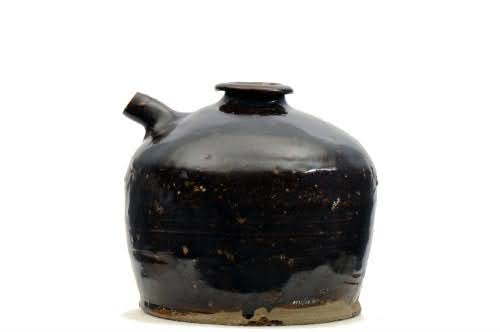
A brown-glazed stoneware jar found at the site of San Jose’s Market Street Chinatown. Spouted jars like this carried soy sauce, vinegar, and oil across the Pacific. Photo: Market Street Chinatown Archaeology Project / History San Jose.
The story starts in 1852. That year, 20,026 Chinese arrivals passed through the San Francisco customs house, up from 2,716 the year before. Most came from Guangdong, the province around Canton, and headed straight for the gold fields.
They didn’t plan to give up their food. Canton was a major soy sauce producer, and its brewers had shipping down to a routine. According to historian Philip Choy, writing for the Society for Historical Archaeology, soybeans were boiled, mixed with flour, left to mold, then fermented in brine for two to six months in sunny yards. The best first draw was siphoned into round brown-glazed stoneware jars, sealed, and wrapped in cord for the voyage.
Those jars went everywhere Chinese workers went: mining camps, railroad camps, city Chinatowns. Archaeologists still dig them up. A soy sauce jug turned up in a late-Victorian neighborhood in downtown San Diego, and another in the gardens of Chinese farmers in Tucson. In the American West, a shard of brown stoneware is one of the surest signs that Chinese cooks once worked nearby.
Curious how the Cantonese soy sauce in those jars compares with Japanese koikuchi or Korean ganjang? Read “Soy Sauce Glossary: Koikuchi, Tamari, Ganjang & More“
Shut out and serving chop suey
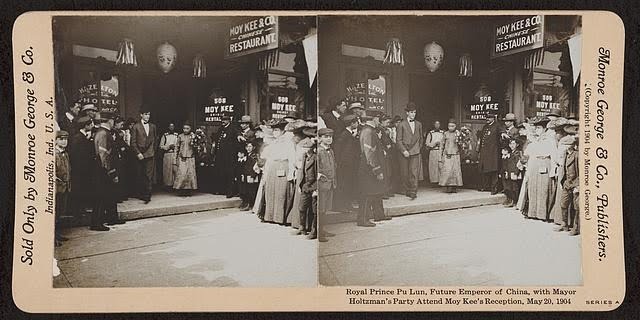
Crowds gather outside Moy Kee’s Chinese restaurant in Indianapolis in 1904, when a visiting Chinese prince stopped in for lunch. Moy Kee served him chop suey. Photo: Monroe George & Co. / Library of Congress
America’s supporting chinese immigration didn’t last. In 1882, Congress passed the Chinese Exclusion Act, which barred new Chinese laborers. Pushed out of the mines and many trades, Chinese workers turned to the jobs left open to them: laundries, and kitchens.
Those kitchens produced chop suey. The name roughly means “assorted mix,” and the dish was a Chinese-American invention: meat and vegetables stir-fried in a wok with a savory sauce, built by Cantonese cooks for American tastes. It was already around by the 1880s.
Then came the publicity. When the Chinese statesman Li Hongzhang visited New York in 1896, newspapers reported that he had snubbed the Western banquet food and happily eaten chop suey. Historians have found no evidence that he did. Restaurant owners used the story anyway, and “chop suey houses” spread across the country. By the 1920s, food historian Andrew Coe writes, the dish was as popular as hot dogs and apple pie.
For many Americans, a plate of chop suey was their first taste of soy sauce, even if nobody called it that. A 1917 Chinese Cook Book in Plain English by Vernon Galster, written for “the person who is a thousand miles from a Chinese Restaurant,” calls for a spoonful of “Chinese salty sauce” in nearly every recipe. Readers who wanted it could order the imported bottles from the author by mail.
The “lo mein loophole”
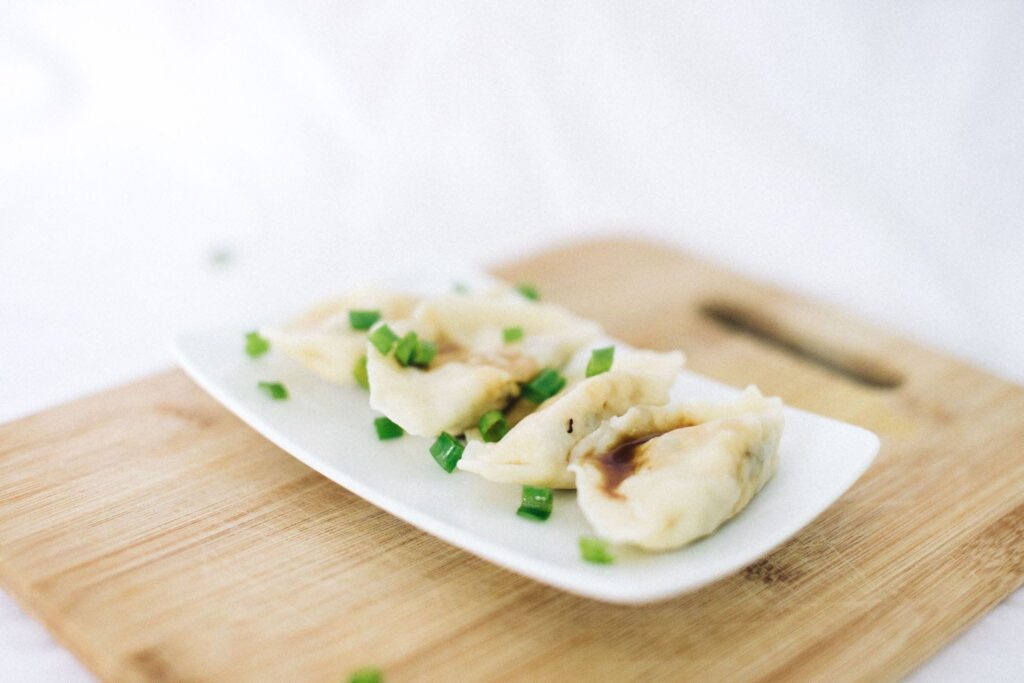
Between 1910 and 1930, the number of Chinese restaurants in the U.S. doubled twice. Each one put soy sauce on more American tables. Photo: Anna Tarazevich / Pexels.
The Exclusion Act fortunately had a gap. Merchants could still get special visas that let them travel to China and bring back relatives to work for them. In 1915, a federal court added restaurant owners to that list, and NPR later nicknamed the result the “lo mein loophole.”
It wasn’t easy to use. According to MIT legal historian Heather Lee, only major investors in a “high-grade” restaurant qualified, and each applicant needed two white witnesses to vouch for them. Owners took turns holding the title to keep the status alive, then brought over family to cook and wait tables.
The effect was huge. Lee, citing economist Susan Carter, says the number of Chinese restaurants in the U.S. doubled from 1910 to 1920 and doubled again by 1930. By then, restaurants had passed laundries as the main employer of Chinese workers. Every new restaurant was one more kitchen ordering soy sauce, and one more town where Americans learned to like it.
Chop suey goes home in a jar
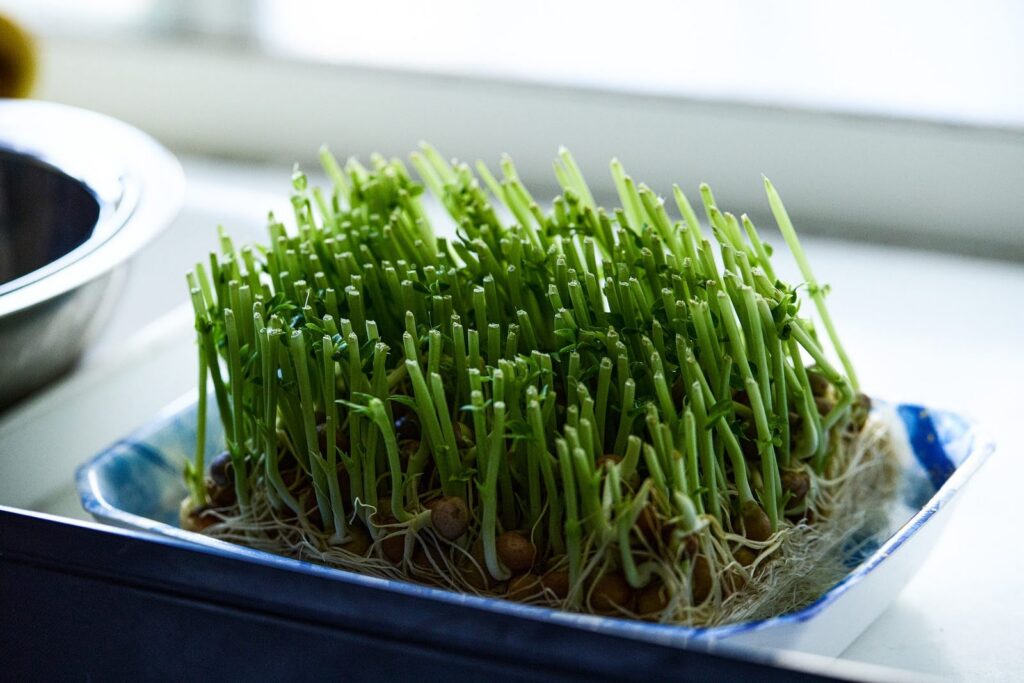
La Choy began with mung bean sprouts like these, grown as a test crop in a Detroit bathtub to supply chop suey cooks. Photo: Pakutaso
Once Americans loved chop suey in restaurants, they wanted to make it at home. One of the brands that met them there started in a bathtub in Detroit, according to Crain’s Detroit Business.
The founders were two University of Michigan classmates. One was a Detroit grocer named Wally Smith, whose restaurant customers kept asking for mung bean sprouts, a chop suey staple. The other was Ilhan New, a Korean immigrant who grew a test crop in his basement bathtub. Fresh sprouts spoiled fast, so the pair sold them in glass jars, and in 1922 they incorporated as La Choy.
The line grew to noodles, vegetables, and sauces. La Choy was selling fermented soy sauce imported from China as early as the 1920s, and it printed recipe pamphlets by the millions to coax home cooks into Chinese cooking. In the 1960s it switched to a soy sauce of its own made from hydrolyzed vegetable protein, a faster chemical process rather than months of brewing.
So the bottle that reached many American pantries took a roundabout path. Chinese cooks created the demand, a Korean immigrant and Michigan grocer filled it, and the sauce inside wasn’t always brewed the traditional way.
To see what traditional brewing looks like, with soy sauce fermented for a year or more in wooden barrels, read “Yugeta Shoyu: Where the Place Is the Main Ingredient“
From clay jug to takeout packet
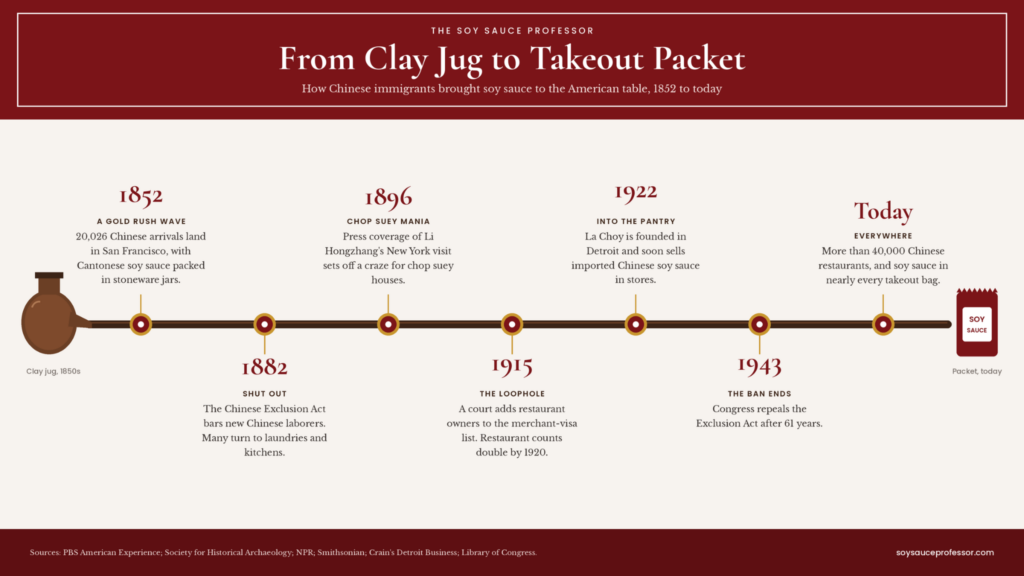
From Gold Rush stoneware to the takeout bag, the 170-year journey that put soy sauce on the American table. Infographic: The Soy Sauce Professor.
Congress repealed the Exclusion Act in 1943, but by then the restaurants had already done their work. Today the U.S. has more than 40,000 Chinese restaurants, more than McDonald’s, Burger King, KFC, and Wendy’s combined. Nearly every one of them hands out soy sauce.
That’s the trip in full. Soy sauce crossed the Pacific in Cantonese stoneware so miners could eat like home. It survived a law built to keep its owners out, because those owners kept cooking. It reached American mouths in chop suey and American pantries in jars, and now it rides home in a little plastic packet stapled to the bag.
The next time a few extra packets fall out of your takeout order, they’re the latest chapter of a story that started with a clay jug on a ship to San Francisco.
Sources
- PBS American Experience, “Chinese Immigrants and the Gold Rush“
- Philip P. Choy, “Interpreting ‘Overseas Chinese’ Ceramics Found on Historical Archaeology Sites,” Society for Historical Archaeology, 2014
- San Diego Archaeological Center, “Artifact of the Week: Soy Sauce Jug“
- Homer Thiel, “The Chinese Gardeners of Historic Tucson,” Desert Archaeology
- Library of Congress, “From Gold Rush to Golden State“
- Smithsonian Magazine, “Chop Suey: An American Classic“
- Wikipedia, “Chop suey“
- Vernon Galster, Chinese Cook Book in Plain English, 1917, via Project Gutenberg
- Maria Godoy, “Lo Mein Loophole: How U.S. Immigration Law Fueled A Chinese Restaurant Boom,” NPR, 2016
- Chris Davis, “Chinese restaurants: A tale of entrepreneurship by necessity,” China Daily USA, 2016
- Amy Elliott Bragg, “The surprising Detroit stories behind La Choy, Mario Olives and Country Crock,” Crain’s Detroit Business